Does Virginia Require a Notary Journal? No for Paper — Records Rules for eNotaries (2026)
Not for traditional work. Virginia's notary law does not require a journal for ordinary, in-person paper notarizations, and the Secretary of the Commonwealth's handbook "recommends that each notary maintain a journal" as a record of all notarial acts and evidence for resolving future disputes. Virginia electronic notaries do have record-keeping obligations for electronic and remote acts. If you hold a standard commission and stamp paper, the record you keep is up to you.
Last updated: August 2026.
How Virginia splits it
Virginia's Notary Act (Code of Virginia title 47.1) governs both traditional and electronic notaries. For traditional notaries, the statute sets duties around identification, presence, and the notarial certificate, and says nothing about keeping a journal.
Electronic notaries are different: § 47.1-14 requires an electronic notary to keep, maintain, and protect a journal of all electronic notarization acts, with a backup, retained at least five years. Each entry carries the date and time, the type of act, the document, the printed name and address of each person, the type of identification used, and the fee. Those duties attach to the electronic commission, not to paper acts.
Why Virginia notaries keep records anyway
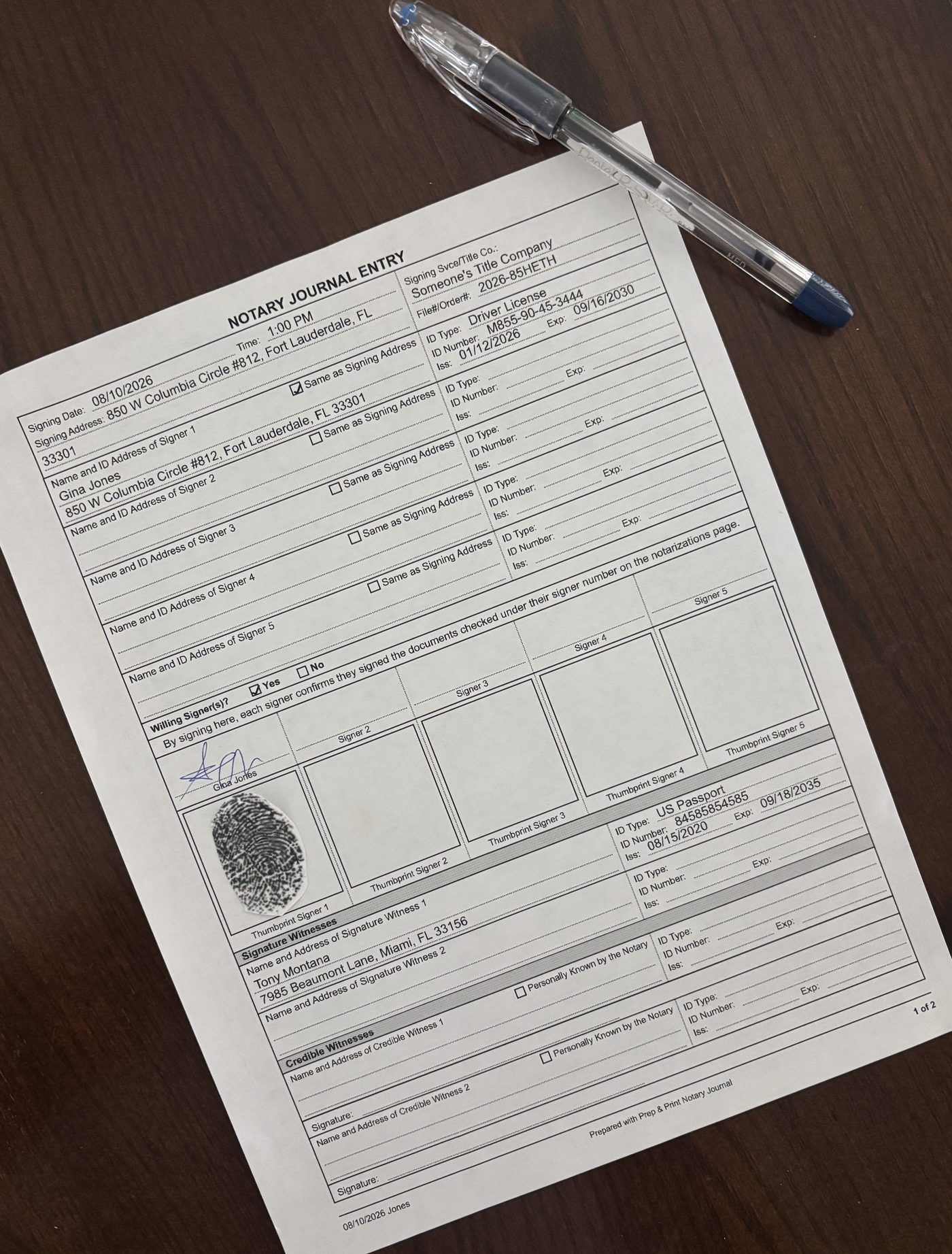
The documents most likely to be challenged later, deeds, powers of attorney, and affidavits, are daily notary work. A journal entry showing the date, the signer, the ID checked, and the signer's own signature is the difference between evidence and recollection when a challenge comes.
What format works in Virginia
Any consistent format: bound book, printed pages kept in order, or an electronic record. Capture each act with the date, time, document type, signer name and address, identification, and fee.
Questions Virginia notaries ask
I'm a Virginia eNotary. Do I need a paper journal too? Your electronic record duties cover electronic acts. Paper acts have no required record, and keeping one protects the same way it does for any notary.
Do loan signings in Virginia require a journal? Not by statute. The journal is the notary's own record. Virginia sets no rules for who may see a voluntary record; in a dispute it can be subpoenaed like any business record.
Should signers sign the journal? Nothing in Virginia law requires it. A signature in your record is strong evidence of personal appearance, which is the fact disputes turn on.
The record without the handwriting
Prep & Print Notary Journal fills in the entry on screen before the signing, prints it for ink signatures at the table, and keeps the saved entry in your browser on your own computer. It costs $19 once, at prepandprintnotary.com.
Every state's rule is on one page: Notary Journal Requirements by State.
Sources: Code of Virginia title 47.1, including § 47.1-14 (electronic journal); Handbook for Virginia Notaries Public (July 2024). General information, not legal advice.