Notary Journal Requirements by State (2026) — Who Needs One and What Kind
Notary Journal Requirements by State (2026)
Some states require every notary to keep a journal. Some require it to be a bound book with numbered pages. Some leave the format to you, and some have no journal law at all. This page lists all 50 states and the District of Columbia, with links to each state's details and statute citations.
Three questions decide what you need:
- Does your state require a journal?
- If yes, must it be a bound book, or is the format yours to choose?
- If the format is yours, do printed and signed pages suit how you work?
Last updated: August 2026. Journal laws have changed in several states recently. New York added a records requirement in 2023, Illinois in 2023, Delaware in 2023, and Utah in 2026. Each state page carries its own statute citation so you can verify against the source.
- Alabama: not required; format is your choice
- Alaska: required only for remote notarizations; recommended for in-person acts
- Arizona: required; paper journal, bound
- Arkansas: not required; format is your choice
- California: required; one active sequential bound journal
- Colorado: required; bound with numbered pages, or approved electronic
- Connecticut: not required; format is your choice
- Delaware: required (2023); bound if on paper
- District of Columbia: required; bound if on paper
- Florida: not required; recommended as best practice
- Georgia: required for self-filer real estate acts (2025), written or electronic; otherwise not required
- Hawaii: required; bound if on paper
- Idaho: not required; format is your choice
- Illinois: required (2023); bound if paper, electronic allowed
- Indiana: not required for paper notarizations
- Iowa: not required; format is your choice
- Kansas: required (2022); bound if on paper
- Kentucky: not required; format is your choice
- Louisiana: required for certain property instruments; see details
- Maine: not required for paper acts; a journal kept on paper must be a bound register
- Maryland: required; bound if on paper
- Massachusetts: required; permanently bound with numbered pages
- Michigan: not required; format is your choice
- Minnesota: not required for paper notarizations
- Mississippi: required; permanently bound with numbered pages
- Missouri: required; permanently bound
- Montana: required; bound, or approved electronic
- Nebraska: not required; format is your choice
- Nevada: required; bound volume with preprinted page numbers
- New Hampshire: not required; format is your choice
- New Jersey: required; bound if on paper
- New Mexico: required; permanently bound with numbered pages
- New York: required (2023); format flexible, ten-year retention
- North Carolina: optional; a kept journal follows the 2024 bound-journal rules
- North Dakota: required only for remote acts; bound register if on paper
- Ohio: not required; format is your choice
- Oklahoma: not required; format is your choice
- Oregon: required; permanently bound with numbered pages
- Pennsylvania: required; bound with numbered pages
- Rhode Island: not required; format is your choice
- South Carolina: not required; format is your choice
- South Dakota: not required; format is your choice
- Tennessee: required if fees are charged; well-bound book or electronic record
- Texas: required; format flexible, electronic records allowed
- Utah: required at new commission or renewal from May 2026; bound if on paper
- Vermont: not required; format is your choice
- Virginia: not required; format is your choice
- Washington: required; permanently bound with numbered pages
- West Virginia: not required; format is your choice
- Wisconsin: not required; format is your choice
- Wyoming: required; hard copy or electronic, format flexible
How to read this list
"Bound" states: the journal must be a physical bound book with numbered pages (or, in some, an approved electronic journal). Printed loose pages do not satisfy those laws. A bound journal is what to buy there.
"Format flexible" states: a journal or record is required, but the law lets you choose how to keep it. Printed pages, kept in order, qualify.
"Your choice" states: no journal law exists for ordinary paper notarizations. Anything you keep is more protection than the law demands. Most notary organizations recommend keeping records anyway, because a journal is your best defense if a notarization is ever questioned.
Remote online notarization is separate everywhere: your RON platform keeps that record.
If your state leaves the format to you
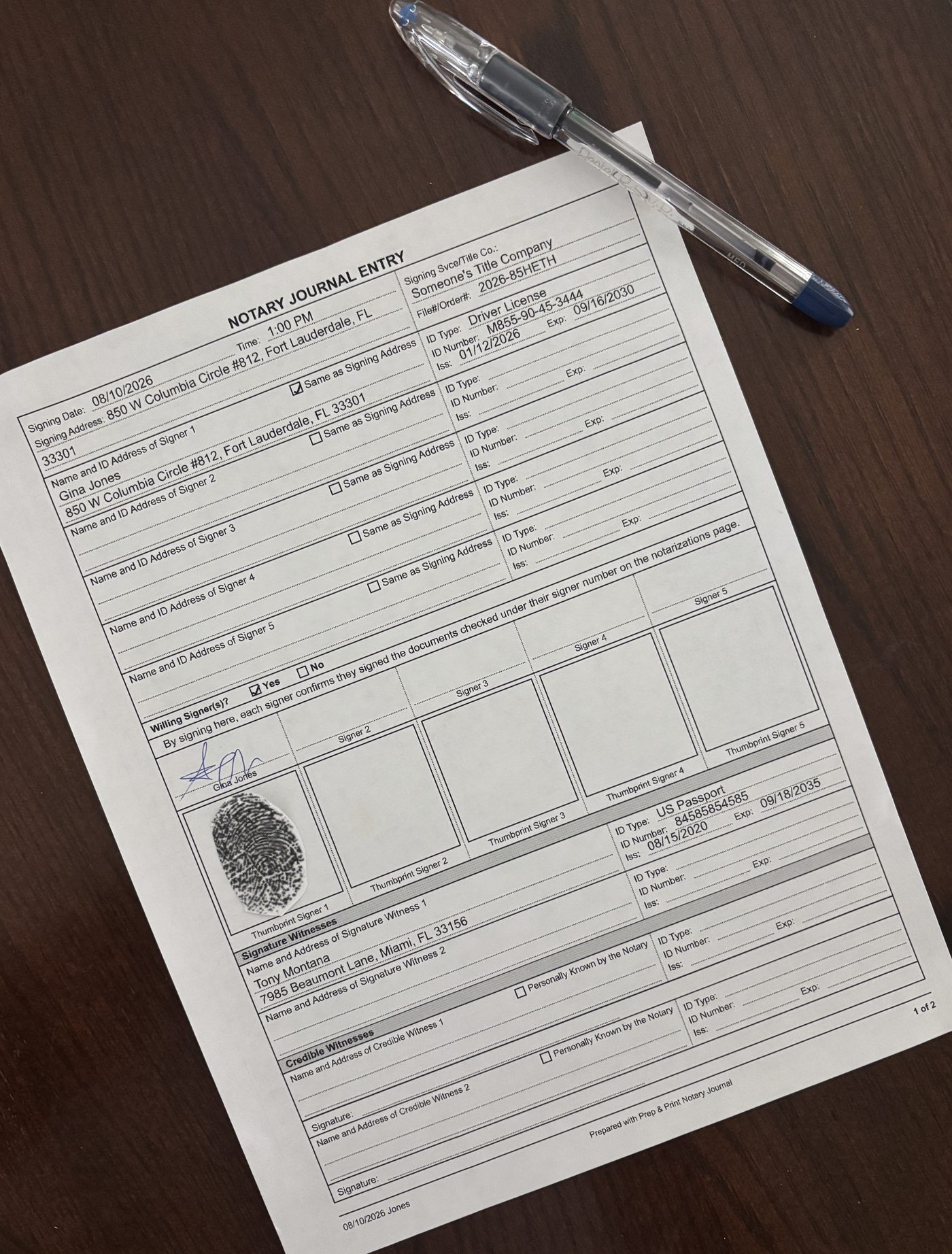
Prep & Print Notary Journal fills in a journal page on screen before the signing. You print it, and signers sign and thumbprint the paper at the table. Entries stay in your browser on your own computer. It costs $19 once, at prepandprintnotary.com.
If your state requires a bound book, that is what you should use. The state pages above tell you which is which, with the statute to check for yourself.
Written by a working Florida notary. This page is general information, not legal advice. Verify against your state's current statute, linked on each state page.