Does Vermont Require a Notary Journal? No — What to Keep Anyway (2026)
No. Vermont does not require notaries to keep a journal for traditional notarizations; the choice belongs to the notary. Remote online notarization is the exception, with its own recording and retention rules for those acts.
Last updated: August 2026.
What Vermont's rules actually say
Vermont's notary law (26 V.S.A. chapter 103) and the Office of Professional Regulation's administrative rules govern commissions, conduct, stamps, and remote notarization. Neither requires a journal for in-person work, and neither says what one must look like. What to record is up to you; the standard shape of a useful entry is the date, time, and type of each act along with the signer and identification details.
The case for keeping one anyway
Vermont notaries handle the documents that get questioned years later: powers of attorney, estate paperwork, property documents. A journal entry with the date, the ID checked, and the signer's own signature is evidence; without one, the answer to "did this person appear before you" is whatever memory has kept. The journal is your own record, and if its contents are ever needed in a dispute, it can be subpoenaed like any business record.
What format works in Vermont
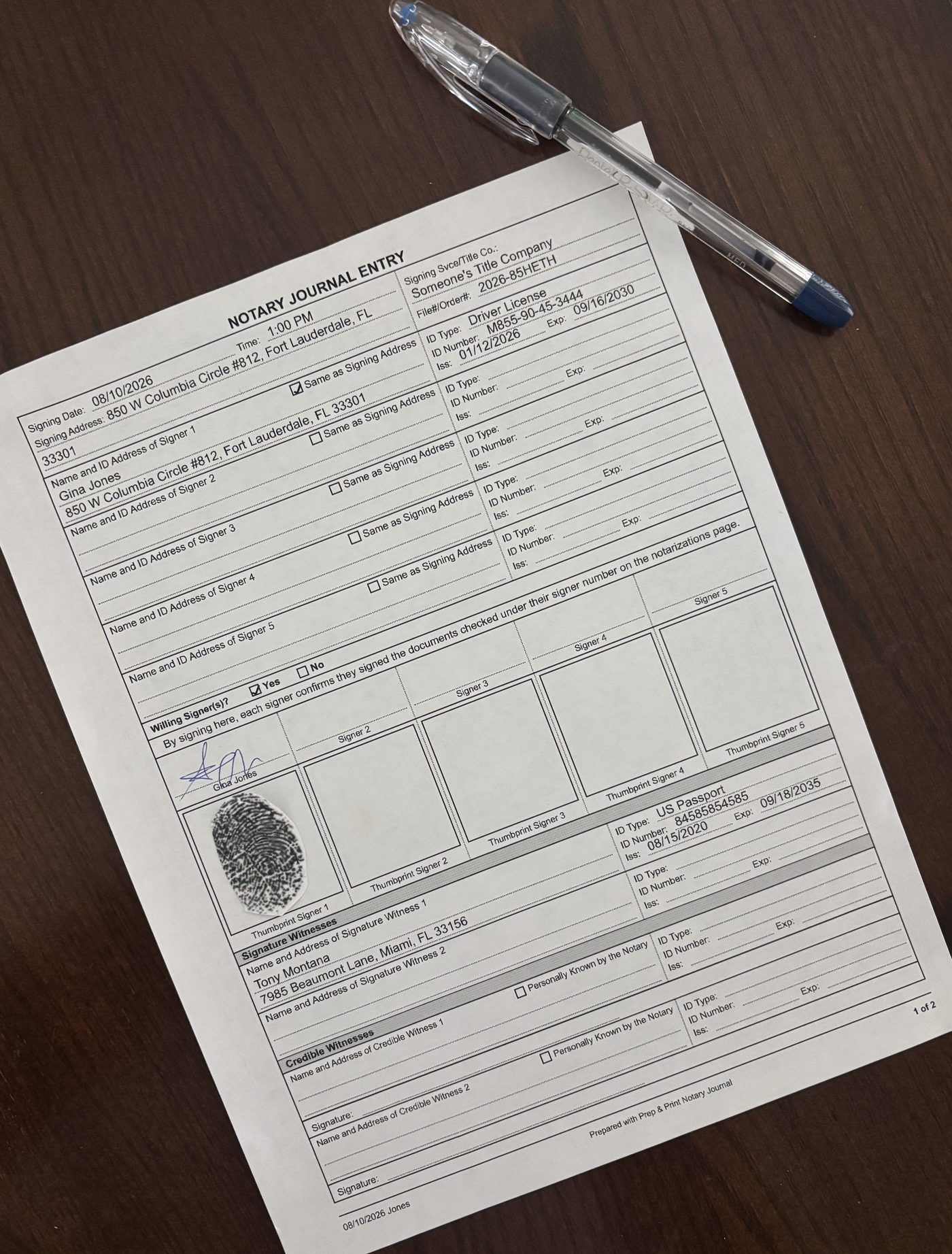
Any format, because the choice is yours: a bound book, printed pages kept in order, or an electronic record. If you keep one, keep it completely: every act, every signer, every ID, in order.
Questions Vermont notaries ask
Do Vermont signing agents need a journal for loan signings? Not by law. Loan signings are also the acts most worth recording, since real estate documents are the ones that get questioned.
Does remote online notarization change anything? Yes. The rules require an audio-visual recording of each notarial act performed for a remotely located individual, made simultaneously with the act and kept at least seven years by the notary, the notary's representative, or a designated repository (OPR Administrative Rules, Part 8-2(f)). In-person work stays yours to document.
Should signers sign my Vermont journal? Nothing requires it. A signature in your record is direct evidence the person appeared before you.
The record without the handwriting
Prep & Print Notary Journal fills in the entry on screen before the signing, prints it for ink signatures at the table, and keeps the saved entry in your browser on your own computer. It costs $19 once, at prepandprintnotary.com.
Every state's rule is on one page: Notary Journal Requirements by State.
Sources: 26 V.S.A. ch. 103 (notaries public); Office of Professional Regulation, Administrative Rules for Notaries Public (Feb. 26, 2025). General information, not legal advice.