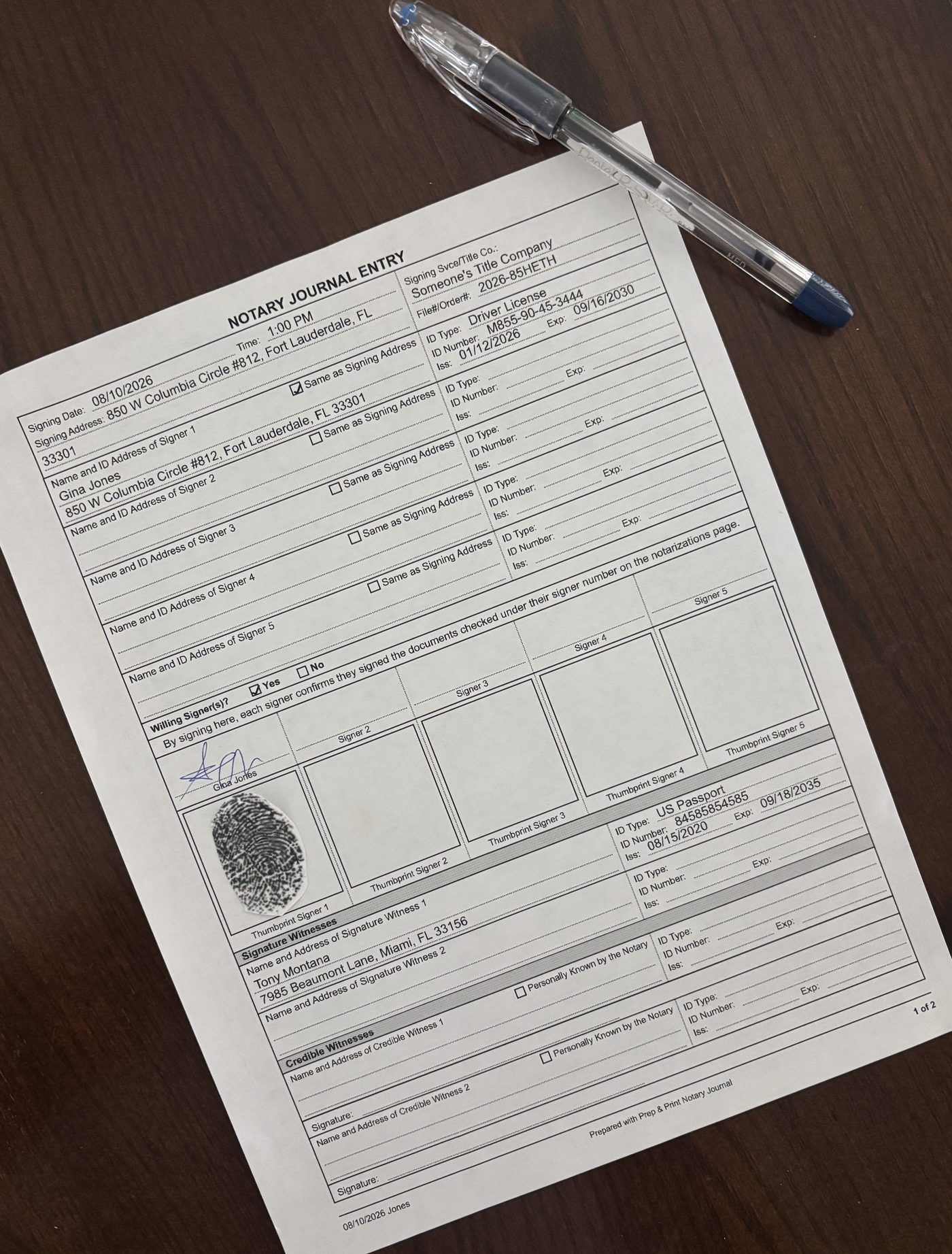
Does Texas Require a Notary Journal? Yes — Here's What Kind (2026)
Yes. Texas requires every notary public to keep a record of each notarization, and the requirement applies whether or not you charge a fee. The format is flexible: the statute allows the records to be kept electronically, and it does not require a bound book.
The statute: Texas Government Code § 406.014 says a notary public "shall keep in a book a record of" each instrument notarized, and then lists what each record must contain. Despite the word "book," subsection (e) settles the format question directly:
"A notary public may maintain the records required by Subsection (a)
electronically in a computer or other storage device."
Last updated: August 2026.
What each Texas record must include
Under § 406.014(a), every entry needs:
- The date of the instrument and the date of the notarization
- The name and mailing address of the signer, grantor, or maker
- How the signer was identified: personally known, identification card issued by a governmental agency, a United States passport, or introduction by another individual (with that individual's name and address)
- If the instrument is proved by a witness, the witness's details
- For property conveyances, the grantee's name and mailing address
What may not go in the book
Texas also says what stays out of the record. The Secretary of State's rules prohibit recording a government-issued identification number from the signer's ID, any other number that could be used to identify the signer, or a biometric identifier, including a fingerprint (1 Tex. Admin. Code § 87.50). Numbers in a mailing address are not covered by the ban, and the statute allows recording the ID card's expiration date. If a prohibited detail lands in the book by mistake, the rule requires redacting it before the book is shown or copied.
How long to keep records
The statute sets no retention period; the Secretary of State's rules do. Records of a notarization other than an online notarization are kept, in a safe and secure manner, for the longer of the term of the commission in which the notarization occurred or three years after the date of the notarization (1 Tex. Admin. Code § 87.54). Records of online notarizations are kept five years, with a protected backup.
What format should a Texas notary use?
Anything reliable. Because subsection (e) permits electronic records and nothing in the statute demands a bound book, Texas notaries use bound journals, loose printed pages kept in order, and electronic records. All qualify, as long as every required detail is captured and kept for the required period.
One caution: whatever you keep is subject to inspection. Section 406.014(c) makes the record public information, so keep it organized and retrievable.
Questions Texas notaries ask
Can I keep my Texas notary records on my computer? Yes. The statute allows records to be maintained "electronically in a computer or other storage device." Print or produce them if requested.
Do Texas signers have to sign my journal? The statute does not require a signature in the record book. Collecting one anyway strengthens the record: a signature in your own book is strong evidence if the notarization is ever disputed.
Does Texas require thumbprints? No, and the rule goes further: a thumbprint may not go in the book at all. The Secretary of State's rules bar biometric identifiers, including fingerprints, from the notary's record (1 Tex. Admin. Code § 87.50). Record how you identified the signer, not a print.
A faster way to keep the Texas record
Prep & Print Notary Journal fills in a journal page on screen before the signing: signers, ID details, documents, fees. You print it, and everyone signs the paper at the table. The entry also stays saved in your browser on your own computer — nothing is sent to a server, which suits a record Texas requires you to keep and produce on request. It costs $19 once, at prepandprintnotary.com.
Every state's rule is on one page: Notary Journal Requirements by State.
Statute: Tex. Gov't Code § 406.014; prohibited entries and retention: 1 Tex. Admin. Code §§ 87.50, 87.54, covered on the Secretary of State's notary education page. General information, not legal advice. Verify against the current statute.