Does Ohio Require a Notary Journal? No — What to Keep Anyway (2026)
No. Ohio's notary law, Revised Code Chapter 147, contains no journal requirement for traditional, in-person notarizations. An Ohio notary can legally complete a career without writing down a single act. Whether that is wise is a different question.
Last updated: August 2026.
What Ohio law does and does not say
Chapter 147 covers commissions, seals, fees, and conduct. It does not tell notaries to keep a record of their in-person acts, and it does not regulate what such a record would look like. Remote online notarization is the exception: every RON act is recorded in an electronic journal with the contents listed in R.C. 147.65(B). In-person work has no required record.
That silence cuts two ways. Nothing forces you to keep a journal, and nothing stops you from keeping one in whatever format serves you.
Why Ohio notaries keep one anyway
The journal exists for the day something goes wrong. A signer's family disputes a power of attorney. A title company questions a signature two years later. A fraud investigator asks what ID you saw. The notary who recorded the act, the ID, and the signature has an answer. The notary who did not has a memory and a liability policy.
Ohio's own commissioning office agrees: the Secretary of State's notary guidance says that while no law requires a journal for traditional notarizations, the office strongly recommends logging every notarial act as a best practice. Not required and strongly recommended describes most of what protects a working notary.
What format works in Ohio
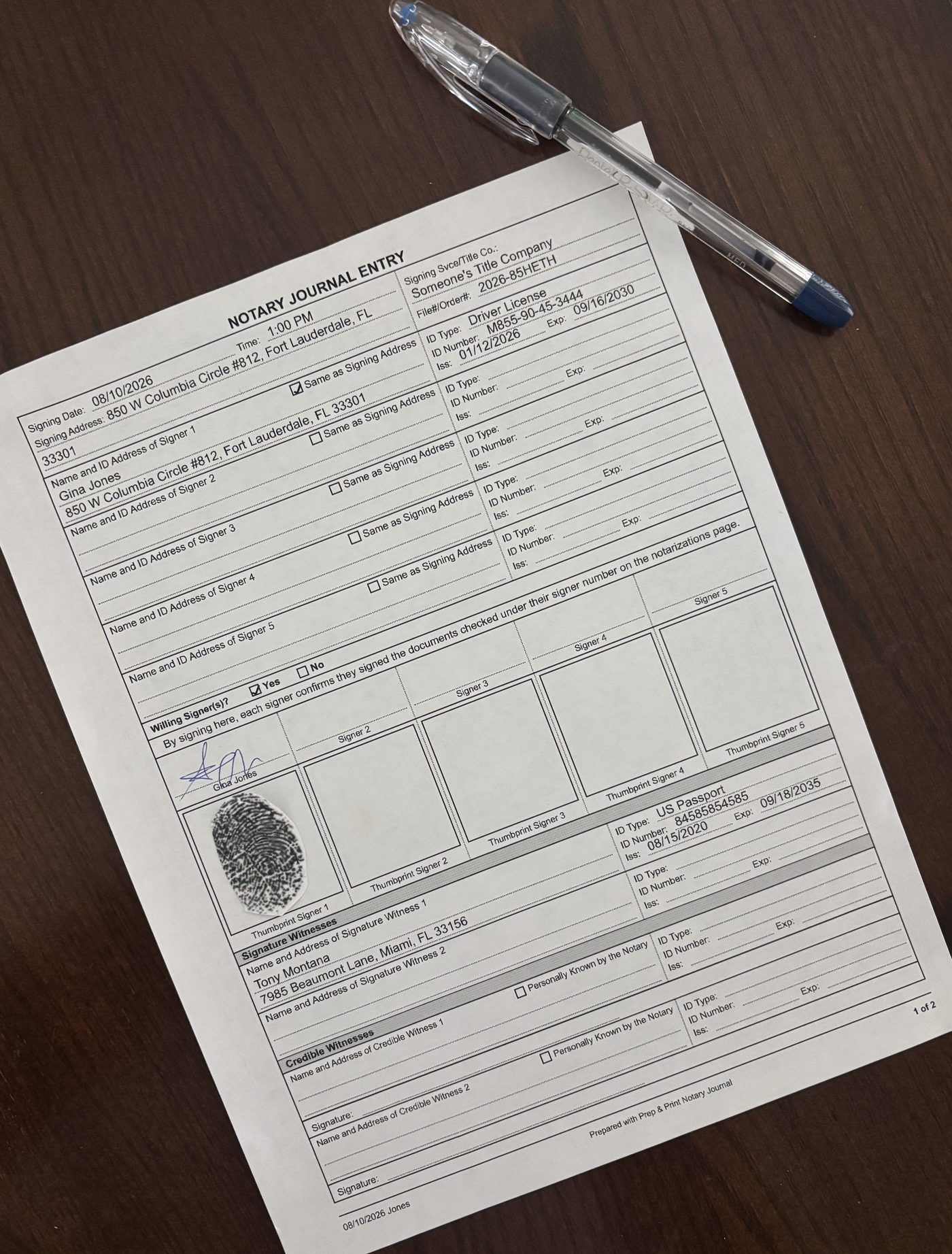
Any format, kept consistently: bound book, printed pages in a binder, or electronic records. Capture the date, the act, the document, the signer, the ID, and the fee, and keep entries in order so any act can be found years later.
Questions Ohio notaries ask
Does anyone ever see my Ohio journal? Ohio has no journal law, so it has no inspection rules either. The journal is the notary's own record; in a dispute it can be subpoenaed like any business record.
Should I collect signatures or thumbprints in my Ohio record? Nothing requires it. Both make the record stronger evidence, and neither costs more than a moment at the table.
Does Ohio's online notary rule change my paper work? No. Online acts are logged in an electronic journal under R.C. 147.65. In-person acts remain unregulated and yours to document.
The record without the handwriting
Prep & Print Notary Journal fills in the entry on screen before the signing, prints it, and signers sign in ink at the table. Entries stay in your browser on your own computer. It costs $19 once, at prepandprintnotary.com.
Every state's rule is on one page: Notary Journal Requirements by State.
Sources: Ohio Rev. Code ch. 147, including § 147.65 (RON electronic journal); Ohio Secretary of State notary resources and FAQs. General information, not legal advice.