Colorado Notary Journal Requirements — Bound Register or Approved Electronic (2026)
Yes. Colorado requires every notary to chronicle all notarial acts in a journal, and a journal kept on paper must be a permanent bound register with numbered pages. Printed loose pages do not satisfy Colorado's law.
The statute: Colorado's Revised Uniform Law on Notarial Acts, at C.R.S. 24-21-519, requires a notary public to maintain a journal chronicling all notarial acts performed. For format, Colorado follows the uniform rule: a journal on a tangible medium must be a permanent, bound register with numbered pages, and an electronic journal must be in a permanent, tamper-evident electronic format. A notary maintains one journal at a time for tangible records.
Last updated: August 2026.
What each Colorado entry must include
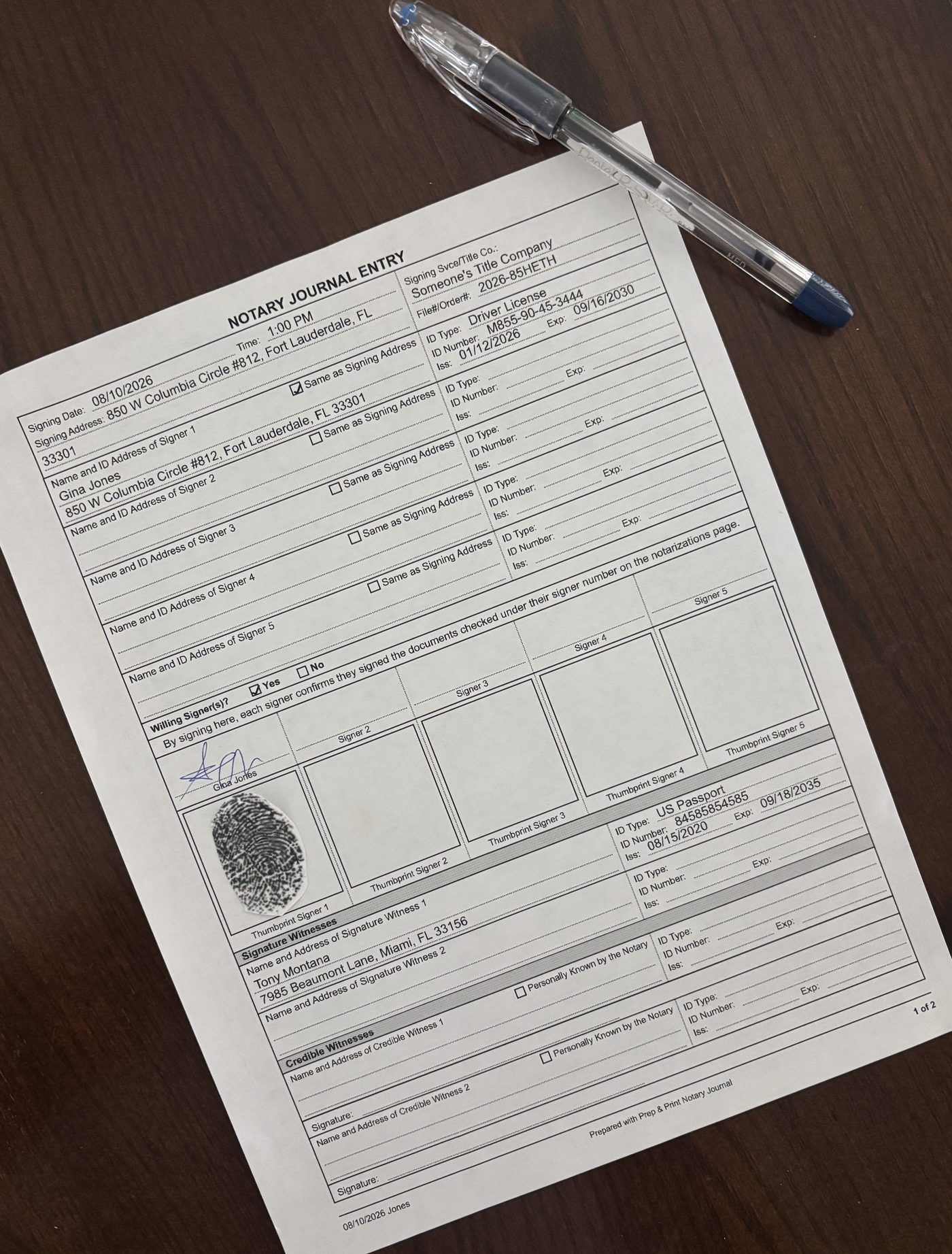
The date and time of the act, a description of the record and the type of act, the full name and address of each individual for whom the act is performed, "the signature or electronic signature of each individual for whom the notarial act is performed," how the signer was identified, and the fee charged (C.R.S. 24-21-519(3)). The signer signs the Colorado journal, which means the book is at the table at every signing. If an interpreter is used, the interpreter's full name, address, and credential number go in too.
Retention, and who may see the journal
When a commission ends, Colorado gives the notary three options: keep the journal for ten years and tell the Secretary of State where it is, leave it with the employer and give the Secretary of State the employer's contact information, or send it to the state archives. The Secretary of State's handbook recommends the first or third, since direct access matters if a notarization is ever questioned.
Access is spelled out too: on a compliant written request naming the parties, the document type, and the month and year, the notary provides a certified copy of an entry. The journal goes to the Secretary of State for inspection or auditing on request, and a law enforcement officer in an official investigation may inspect it without restriction.
What Colorado notaries should buy
A bound journal with numbered pages from any notary supplier, or an electronic journal that meets the Secretary of State's rules. Nothing else satisfies the statute for the journal itself.
Choose a register with numbered pages and room for your volume. One tangible journal at a time holds every act until it fills; then the next book starts.
Questions Colorado notaries ask
Can I keep my Colorado journal electronically? Yes, in a permanent, tamper-evident electronic format that complies with the Secretary of State's rules. Loose printed pages qualify as neither a bound register nor a compliant electronic journal.
How many journals can I keep? One tangible journal at a time. A new one starts when the old one is full.
Do signers sign the Colorado journal? Yes. The signature or electronic signature of each individual for whom the act is performed is a required entry (C.R.S. 24-21-519(3)).
How long do I keep my Colorado journal? Ten years after the last entry, unless it goes to your employer or the state archives when your commission ends, with notice to the Secretary of State either way.
The honest note from us
Prep & Print Notary Journal sells a $19 app that prints filled-in journal pages, and printed pages do not comply with Colorado's bound-register rule. If you are commissioned in a state that leaves the journal format to you, the app is at prepandprintnotary.com. Colorado notaries: buy the bound book or an approved electronic journal.
Update, September 2026: we make a bound edition now. The Prep & Print bound journal is on Amazon — permanently bound, one signing per two-page spread, preprinted page and entry numbers, signature and thumbprint boxes, in five cover colors.
Every state's rule is on one page: Notary Journal Requirements by State.
Sources: C.R.S. 24-21-519 (journal); Colorado SOS Notary Handbook. General information, not legal advice.