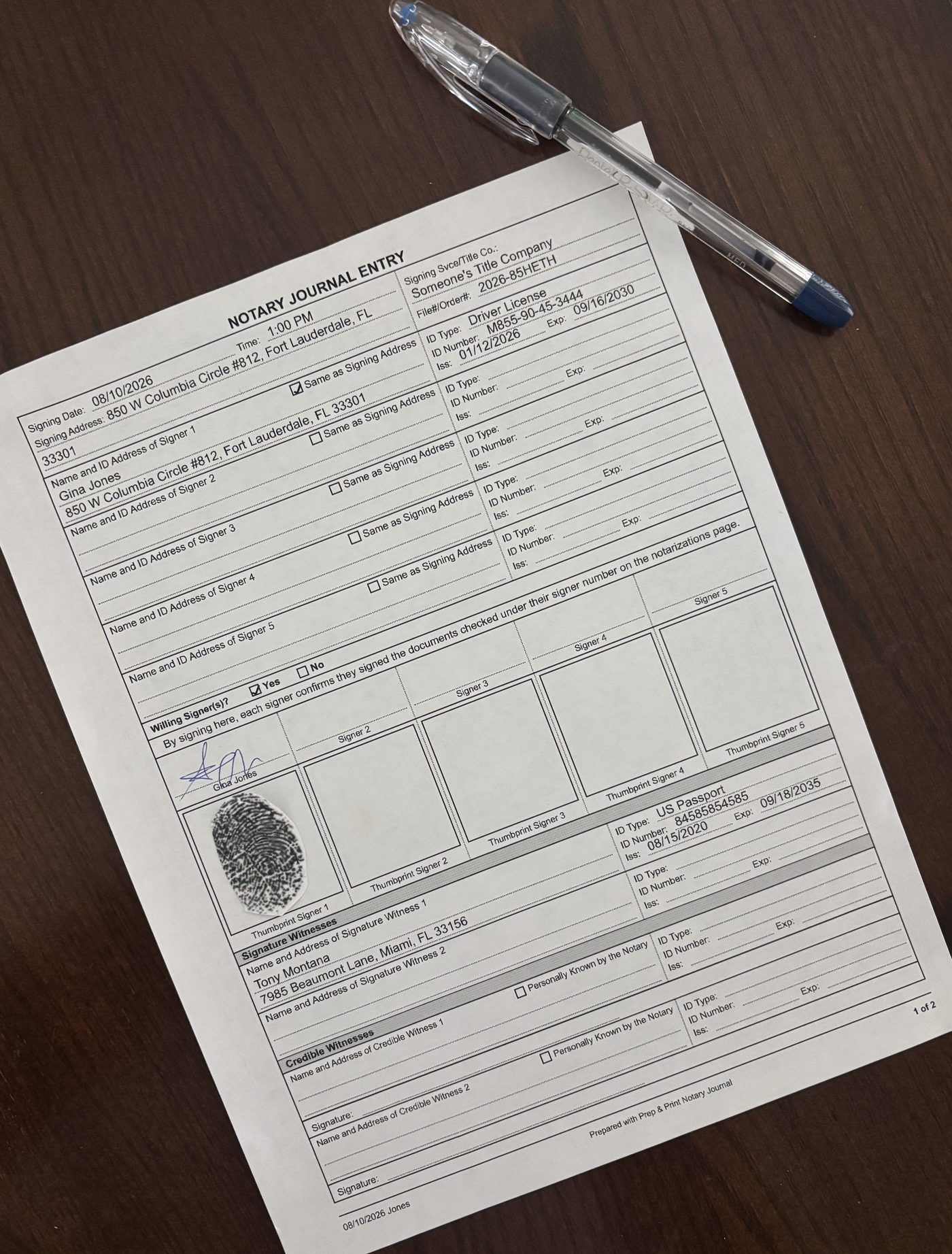
Arizona Notary Journal Requirements — New Thumbprint Rule (2026)
Yes, and Arizona is specific about it. Every Arizona notary must keep a journal, and for ordinary paper notarizations the journal itself must be paper. Printed loose pages do not satisfy the requirement; Arizona's law contemplates a proper journal maintained as a permanent record. A new thumbprint requirement for property documents and powers of attorney takes effect September 12, 2026, covered below.
The statute: Arizona Revised Statutes § 41-319 requires that a notary keep a paper journal to chronicle all notarial acts performed on tangible records. For electronic records, the notary may keep a paper journal or one or more electronic journals. The statute adds two housekeeping rules:
A notary public shall keep only one paper journal at a time.
The notary public shall record all notarial acts in chronological
order.
Last updated: August 2026.
What each Arizona entry must include
Section 41-319 lists the required contents of every entry:
- The date of the notarial act
- A description of the document and the type of act
- The printed full name and address of each individual for whom the act is performed
- The signature of each individual, when a paper journal is used
- The evidence of identity relied on, or a notation that the signer was personally known to the notary
- A description of the identification card or document, including its date of issuance or expiration
- The fee, if any
New from September 12, 2026: thumbprints for property documents
Senate Bill 1479, signed in April 2026 as part of Arizona's response to deed fraud, adds a thumbprint rule. Starting September 12, 2026, when the document being notarized is a deed, quitclaim deed, deed of trust, another document affecting real property, or a power of attorney, the notary must require the signer to place a right thumbprint in the journal. If the right thumbprint is not available, the signer's left thumb or any available finger goes in instead, with a note in the journal saying which. If the signer is physically unable to provide any print, the notary notes that in the journal along with an explanation of the condition.
The requirement does not apply to a trustee's deed resulting from a judicial or nonjudicial foreclosure, to a deed of release and reconveyance, or to a remote online notarization performed in compliance with Arizona's remote-notarization statutes when the journal includes the signer's identification credential number and the notary keeps the audiovisual recording for at least seven years.
Retention and what happens later
Arizona treats journal entries as public records, with one exception: records of notarial acts that would violate the attorney-client privilege, or that are confidential under federal or state law, are not public records. On a written request naming the month and year of the act, the person whose signature was notarized, and the type of record, a member of the public may view or copy an entry, and the notary furnishes certified copies of public journal records on request.
When a commission ends, whether by resignation, revocation, expiration, or death, the journal and records go to the Secretary of State within three months, by certified mail or another method that provides a receipt; non-public records are excepted, and the statute sets a fine of $50 to $500 for failing to comply (A.R.S. § 41-317). A lost or stolen journal is reported to the Secretary of State in writing within ten days, and a theft is also reported to law enforcement (A.R.S. § 41-323). Treat the journal as an official record rather than personal notes, because that is exactly how Arizona law treats it.
What Arizona notaries should buy
A bound paper journal with numbered pages, from any notary supplier. Arizona's one-paper-journal-at-a-time rule and chronological-order rule fit a bound book and do not fit loose printed sheets.
One paper journal at a time means the active book holds every act, in chronological order, until it fills. Choose one with numbered pages and enough entry lines for your volume.
Questions Arizona notaries ask
Can I keep my Arizona journal electronically? For notarizations of paper documents, no: the statute requires a paper journal. Electronic journals are permitted only for notarizations of electronic records.
Can I keep separate journals for different clients? Only in one situation. The rule is one paper journal at a time, in chronological order, except that a notary whose work produces entries that are not public records, such as acts covered by attorney-client privilege, must keep two journals: one for public entries and one for the confidential entries. The confidential journal is the property of the notary's employer and stays with the employer if the notary leaves the job (A.R.S. § 41-319).
Do signers sign the Arizona journal? Yes. For a paper journal, the statute requires the signature of each individual for whom a notarial act is performed. The signer signs your journal at the table, every time.
Do Arizona signers thumbprint the journal? Starting September 12, 2026, yes, for deeds, quitclaim deeds, deeds of trust, other documents affecting real property, and powers of attorney. The signer's right thumbprint goes in the journal, and the law sets out what to do when a right thumbprint is not available. Other documents do not call for a print.
The honest note from us
Prep & Print Notary Journal sells a $19 app that prints filled-in journal pages, and printed pages are not an Arizona journal. If you are commissioned in a state that leaves the journal format to you, the app is at prepandprintnotary.com. Arizona notaries: keep the paper journal the statute requires.
Update, September 2026: we make a bound edition now. The Prep & Print bound journal is on Amazon — permanently bound, one signing per two-page spread, preprinted page and entry numbers, signature and thumbprint boxes, in five cover colors.
Every state's rule is on one page: Notary Journal Requirements by State.
Statutes: A.R.S. § 41-319, § 41-317, and § 41-323; thumbprint rule: S.B. 1479 (2026), effective September 12, 2026. General information, not legal advice.